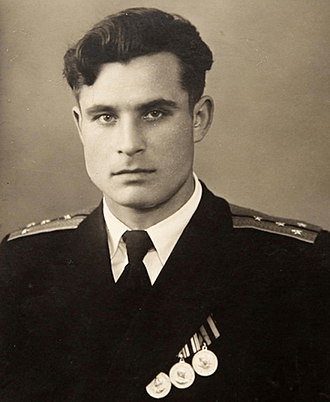
On 27 October 1962, during the Cuban Missile Crisis, a group of 11 United States Navy destroyers and the aircraft carrier USS Randolph located the diesel-powered, nuclear-armed Foxtrot-class submarine B-59 near Cuba. Despite being in international waters, the United States Navy started dropping signaling depth charges, explosives intended to force the submarine to come to the surface for identification. There had been no contact from Moscow for a number of days and, although the submarine’s crew had earlier been picking up U.S. civilian radio broadcasts, once B-59 began attempting to hide from its U.S. Navy pursuers, it was too deep to monitor any radio traffic. Those on board did not know whether war had broken out or not. The captain of the submarine, Valentin Grigorievitch Savitsky, decided that a war might already have started and wanted to launch a nuclear torpedo.
Unlike the other submarines in the flotilla, three officers on board B-59 had to agree unanimously to authorize a nuclear launch: Captain Savitsky, the political officer Ivan Semonovich Maslennikov, and the chief of staff of the flotilla Arkhipov. Typically, Soviet submarines armed with the “Special Weapon” only required the captain to get authorization from the political officer to launch a nuclear torpedo, but due to Arkhipov’s position as chief of staff, B-59’s captain also was required to gain his approval. An argument broke out, with only Arkhipov against the launch.
Even though Arkhipov was second-in-command of the submarine B-59, he was in fact chief of staff of the submarine flotilla, including B-4, B-36 and B-130. According to author Edward Wilson, the reputation Arkhipov had gained from his courageous conduct in the previous year’s K-19 incident also helped him prevail. Arkhipov eventually persuaded Savitsky to surface and await orders from Moscow. This may have effectively averted a nuclear war which probably would have ensued if the nuclear weapon had been fired.
Arthur M. Schlesinger Jr., an advisor for the John F. Kennedy administration and a historian, stated “This was not only the most dangerous moment of the Cold War. It was the most dangerous moment in human history.”
 Unsung Heros
Leave a comment